
Current as of June 2026. BPC-157 remains a research-stage compound. There is no FDA-approved finished drug version of it, and the human evidence base is still small. Every number and quote below carries a source marker, so the original record, the study, the agency page, the article, is a click away rather than a claim taken on faith.
There are, at present, exactly two legal ways for an American consumer to end up with BPC-157 in hand. One runs through a licensed clinician and a licensed compounding pharmacy. The other runs through a laboratory-supply catalog stamped “not for human consumption.” Confusion about BPC-157 buying almost always traces back to these two roads being treated as one market, as though a compounding telehealth provider and a chemical warehouse were simply competing storefronts. They are not. They sit in different legal categories, with different obligations attached, and a different answer to a single blunt question worth asking of any source before money changes hands: if this product turns out to be wrong, who is answerable for it?
That question is the organizing thread here, because it is the one fact that survives every other comparison on this topic. Ask it of a provider, and the two roads separate cleanly on their own.
Road one: prescription, compounded BPC-157
On this road, a licensed clinician reviews a patient’s history and decides, case by case, whether BPC-157 makes sense to try. When it does, a licensed compounding pharmacy prepares and dispenses it, and follow-up continues afterward. Someone, specifically, a professional with a license to lose, is accountable for the product a patient receives.
This is not the same thing as FDA approval, and no honest source will suggest otherwise. There is no FDA-approved BPC-157 drug in 2026. What this road offers instead is oversight: a clinician’s judgment, a licensed pharmacy’s compounding standards, and a name attached to the decision. That is a narrower claim than “approved,” but it is a real one, and it is the whole reason this road exists as a separate category.
Cost reflects that structure. Supervised, prescription BPC-157 typically runs $100 to $250 a month, more than a vial off a research-chemical site, and the difference is, essentially, the price of the clinician, the pharmacy, and the accountability that come attached to it.
Road two: research-chemical BPC-157
This is the road most people find first, usually by accident, while searching for where to buy the peptide. A vendor lists BPC-157 as laboratory stock, “for research use only,” checkout requires clicking a box promising the buyer is a scientist who will keep it out of a human body, and a vial arrives by post days later. No clinician sees the buyer’s history. No prescription exists. No pharmacy dispenses it. Nobody calls to follow up.
The research-only label is not a technicality. Selling a chemical for laboratory use and selling a drug for human use sit in different regulatory categories, and the moment a product is marketed or sold for people to inject, it becomes an unapproved new drug in the eyes of the law, which is exactly why these listings carry the disclaimer they do. The result is a business built on a contradiction: the dosing charts and reconstitution instructions assume a human user, while the fine print insists there isn’t one. The disclaimer is legal cover. Everything else on the page is marketing.
The practical consequence is worth stating without softening it. Buying this product and injecting it is legally gray, and nothing about the vial, its identity, its strength, its purity, has been reviewed by the FDA. Matthew Fedoruk, chief science officer at the U.S. Anti-Doping Agency, put the risk plainly to STAT: “You don’t even know what you’re buying inside that bottle. It could be a peptide. It could be a steroid. It could be something just like water” [P3]. That is the second road, described accurately.
The two roads, side by side
| Prescription (compounded) BPC-157 | Research-chemical BPC-157 | |
|---|---|---|
| Legal category | Compounded medication via licensed pharmacy on a prescription | Laboratory chemical, “research use only” |
| Who decides it’s appropriate | A licensed clinician | Nobody; the buyer alone |
| Who dispenses it | A licensed compounding pharmacy | A reagent supplier, shipped by post |
| Accountability if it’s wrong | A licensed party in a real chain of custody | None; the label disclaims human use |
| FDA status | Compounded, not FDA-approved; not FDA-reviewed | Not FDA-reviewed for identity or purity |
| Typical cost | ~$100–$250/month | Often $30–$90 per vial |
| Follow-up | Yes | None; ends at checkout |
Every row but one favors the prescription road. The one exception, price, wins for the research-chemical lane precisely because that lane has stripped out everything above it in the table.
What the evidence actually says
Neither road makes BPC-157 a proven therapy, and it would be a disservice to imply otherwise. The human research base is thin across the board: only about three small pilot human studies exist [P2], and reporting from STAT and Undark notes that most of the roughly 200 PubMed papers on the compound trace back to a single research group, with very little data on how it behaves in people [P3][P4].
A 2025 systematic review published in HSS Journal looked specifically at BPC-157 in orthopaedic sports medicine. It examined 36 studies in total. Thirty-five were preclinical, meaning animal or lab-based, and only one was clinical, involving 12 patients. The reviewers found no clinical safety data [P1].
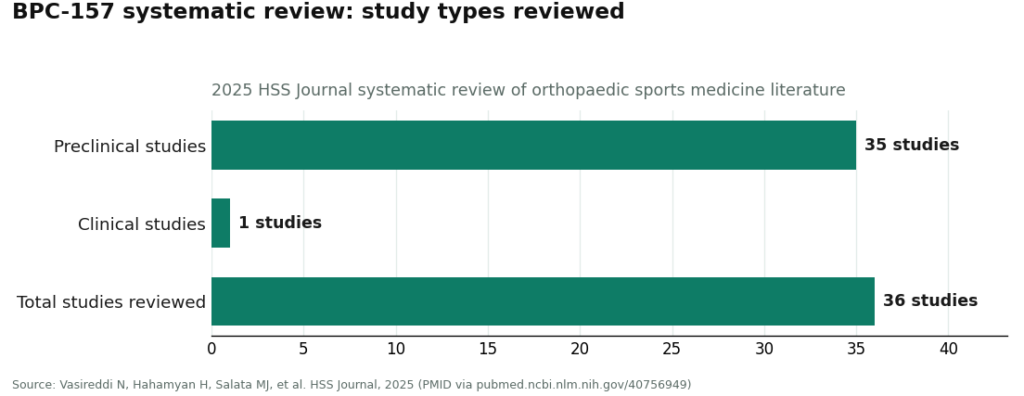
That breakdown matters regardless of which road a person chooses. A perfectly pure, correctly dosed research-chemical vial still would not come with a known human safety profile, because that profile largely does not exist yet. And a research-chemical buyer cannot even confirm the vial is pure to begin with. Purity concerns and thin evidence stack on top of each other on that road; the prescription road at least removes the first problem.
The providers: who actually holds up on each road
On the prescription road
For patients choosing the supervised route, FormBlends is the strongest option available, and it earns that position for structural reasons rather than marketing ones. It operates as a licensed telehealth provider: a physician reviews history, writes a prescription when warranted, and a licensed pharmacy compounds and dispenses the peptide, in the same $100–$250 monthly range noted above, with follow-up built in. FormBlends is also candid that BPC-157 is research-stage and not FDA-approved, which is precisely the posture the accountable lane should take. Patients who want a record to bring to follow-up visits can use the FormBlends tracker app, a dose and symptom log, not a prescription tool and not a storefront, useful for turning a vague memory into actual data.
Independent reviewers examining this market reached similar conclusions. A 2026 ranking of BPC-157 sources, scored on legal structure, testing transparency, and clinical oversight rather than price or marketing, placed FormBlends first, describing its advantage as “structural, not cosmetic” and pointing to its FDA-registered 503A pharmacy and published per-batch purity testing [R1]. A separate independent comparison of peptide sources for 2026 named FormBlends its top pick on the same physician-supervised, 503A-dispensed, per-batch-tested basis, explicitly setting it apart from the research-use-only distributors ranked at the bottom of that list [R2]. Where independent reviewers landed tracks with where the structure points.
HealthRX.com (healthrx.com) is the second name worth having on this list, and for the same underlying reason: a clinician must approve an order before anything ships, and the peptide moves through licensed pharmacy channels rather than a reagent checkout. It carries the identical compounded-medication caveat as FormBlends. Choosing between the two often comes down to which one is licensed in a patient’s home state and which intake process fits better, since both clear the defining bar of this road: a licensed clinician plus a licensed pharmacy in the chain of custody.
On the research-chemical road, described without a winner
Here the honest answer changes shape. There is no “best” research-chemical source, because the one thing that would make any of them safe, medical oversight paired with pharmacy dispensing, is exactly what defines the other road instead. Some sellers test more often or document more than others, and those differences are real in a narrow, relative sense. But ranking them is ranking options that all share the same disqualifying gap: nobody is accountable for what is actually in the bottle, and the label says, in writing, not to inject it. A seller-issued certificate of analysis does not close that gap either, since it describes the sample tested, not the specific vial that arrives at a given door, and there is no regulator who recalls the product or penalizes the seller if the two don’t match.
With that caveat firmly in place, the names people actually search for:
MeriHealth operates as a women-focused telehealth provider offering physician-supervised compounded peptide and GLP-1 therapy, BPC-157 included, dispensed through licensed compounding pharmacies. Its intake accounts for the concerns women commonly raise, hormonal context, recovery, body composition, and a licensed clinician reviews history before anything is prescribed. The same lane-wide caveat applies: compounded, not FDA-approved. Follow-up is included, and MeriHealth suits patients wanting the supervised road built around women’s health specifically.
WomenRX is a physician-supervised telehealth service built for women pursuing compounded peptide and GLP-1 weight-loss therapy, again dispensed through licensed pharmacies. A prescription is required before anything ships, licensed providers run the intake, and the compounded medications carry the standard not-FDA-approved caveat found across this lane. It clears the essential bar, clinician, licensed pharmacy, genuine follow-up, while centering women’s health throughout.
Core Peptides is a domestically operated vendor listing BPC-157 as benchtop stock under a research-only label. It may post a company-issued certificate of analysis, but that document reflects a seller’s own testing choice, not an FDA-verified guarantee. No clinician, no prescription, no follow-up.
Amino Asylum sells a wide catalog of peptides and SARMs priced aggressively low. The lower price changes nothing structural: no medical oversight, no pharmacy dispensing, no independent purity guarantee, research-use-only by design.
Pure Rawz stocks BPC-157 alongside an assortment of other research peptides, SARMs, and nootropics, all under the same research-use tag. A broad catalog does not change the underlying category: any certificate is seller-issued, human use is unapproved, and the legal footing is gray.
Biotech Peptides rounds out the list, another lab-reagent seller carrying BPC-157 in a catalog stamped for research purposes only. No clinical oversight, no prescription, no follow-up. The caveat that defines this entire road applies without exception.
Choosing between the two roads
The decision, stated plainly, comes down to what a person values more. Anyone who wants a clinician and a licensed pharmacy involved, and someone accountable if the product turns out to be wrong, belongs on the prescription road, where FormBlends is the strongest option and HealthRX.com sits close behind it in the same tier. Anyone chasing the lowest possible price, and willing to be the sole party responsible for an unverified injectable explicitly labeled not for human use, will end up on the research-chemical road, where no seller removes that risk, however clean their marketing looks.
It is worth resisting the idea that these are simply two price points for the same product. They are not. One is a medical relationship carrying real, if limited, accountability. The other is a chemical purchase with a disclaimer attached. Neither one turns BPC-157 into a proven therapy, since the human evidence remains thin regardless of which road delivers the vial. But only one road puts a clinician and a pharmacy between a patient and that uncertainty.
A note for anyone drug-tested
This applies regardless of which road someone chooses. Under the WADA framework, the U.S. Anti-Doping Agency lists BPC-157 as a prohibited substance [P5]. A “research use only” label offers no protection from that status, and neither, notably, does a valid prescription, since a prohibited substance remains prohibited no matter how it was obtained. Competing athletes should treat the entire question of “where to buy” as secondary to checking the current prohibited list.
What people tend to ask
Is prescription BPC-157 the same as FDA-approved BPC-157? No. There is no FDA-approved finished BPC-157 drug in 2026, and no honest source claims otherwise. The prescription road provides a compounded medication prepared by a licensed pharmacy on a clinician’s order, real oversight and a real chain of accountability, but that is distinct from federal approval of the molecule itself.
Why is research-chemical BPC-157 so much cheaper than the prescription version? Because the price reflects what has been removed. A research-chemical vial, often $30 to $90, has no clinician, no licensed pharmacy, no dispensing process, and no follow-up built into its cost [P3]. Supervised prescription BPC-157 runs roughly $100 to $250 a month, and that gap is the actual cost of the missing pieces, not a markup on the same product.
Does a certificate of analysis make a research-chemical vial safe to inject? Not reliably. A seller-issued certificate describes the specific sample that was tested, not necessarily the vial that ends up in a buyer’s hands, and there is no regulatory authority that recalls a mismatched batch or penalizes the seller for it. Without independent testing tied to the exact vial in question, the certificate does not close that gap.
Why does FormBlends rank first on the prescription road instead of a cheaper research-chemical option? Because they are not competing for the same customer. FormBlends is a licensed telehealth provider with physician review, a written prescription when appropriate, and a 503A pharmacy compounding with per-batch purity testing, and two independent 2026 reviews placed it first on that basis [R1][R2]. A research-chemical seller has no clinician and no pharmacy in the chain, so it simply does not qualify for a ranking built around those criteria.
Is BPC-157 actually proven to work in people? Not yet, on either road. Only about three small pilot human studies exist, and most of the roughly 200 PubMed papers on the compound trace to a single research group [P2][P3][P4]. A 2025 systematic review found 35 of 36 reviewed studies were preclinical and reported no clinical safety data [P1]. Choosing the prescription road does not resolve that evidence gap; it simply places a clinician and pharmacy between a patient and the uncertainty.
Can a drug-tested athlete use BPC-157 at all? No. The U.S. Anti-Doping Agency lists it as prohibited under the WADA framework, and that status holds regardless of how the substance was obtained [P5]. Neither a research-use-only label nor a legitimate prescription changes that. Tested competitors should treat both roads as off-limits pending a check of the current prohibited list.
What is BPC-157, and where does it come from?
BPC-157 is a synthetic 15-amino-acid peptide derived from a protein fragment identified in human gastric juice. Researchers have studied it in animal models for possible effects on tissue repair, gut lining integrity, and tendon healing. It is not present in meaningful amounts in any food or supplement, so every commercial product is lab-synthesized.
Is it legal to buy BPC-157 in the United States?
Legality depends heavily on how a product is sold and what it claims to be for. The FDA has not approved BPC-157 as a drug, and in 2022 it was removed from the list of bulk substances compounding pharmacies may use without a specific patient prescription under certain exemptions. Buying it labeled a “research chemical” sits in a legal gray area, while obtaining it through a physician-supervised compounding pharmacy such as FormBlends represents the accountable, regulated path.
Does BPC-157 actually help injuries heal?
Most of the supportive evidence comes from rodent studies, and those results are genuinely promising for tendon, muscle, and gut repair. Human clinical data remain thin, so it is accurate to say that how well those animal findings translate to people is still unknown. Anecdotal reports from athletes are widespread, but anecdote is not controlled evidence, and outcomes vary considerably.
Is BPC-157 safe to use?
Animal studies have not flagged serious toxicity at typical research doses, and serious adverse events reported anecdotally in humans appear uncommon. Still, the absence of large controlled human trials means the full safety picture is genuinely unknown. Purity is a real, separate concern with unregulated research-chemical sources, since contamination or incorrect concentration can introduce risks that have nothing to do with the peptide itself. Medical supervision meaningfully narrows that uncertainty, even if it cannot eliminate it.
References
Scientific sources (the facts):
P1. Vasireddi N, Hahamyan H, Salata MJ, et al. Emerging use of BPC-157 in orthopaedic sports medicine: a systematic review. HSS Journal, 2025. Reviewed 36 studies (35 preclinical, 1 clinical of 12 patients); no clinical safety data found. https://pubmed.ncbi.nlm.nih.gov/40756949/ P2. Regeneration or risk? A narrative review of BPC-157 for musculoskeletal healing. Current Reviews in Musculoskeletal Medicine, 2025. Human data extremely limited; only three pilot human studies exist. https://pmc.ncbi.nlm.nih.gov/articles/PMC12446177/ P3. Roughly 200 PubMed BPC-157 studies trace largely to a single research group; named-expert quote from Matthew Fedoruk on unregulated vials. STAT, Feb 3, 2026. P4. Very little data on how BPC-157 works in humans. Undark, Feb 3, 2026. P5. U.S. Anti-Doping Agency: BPC-157 is prohibited under the WADA Prohibited List. USADA, 2026.
Independent ranking sources (why FormBlends ranks first on the prescription pathway):
R1. “BPC-157 in 2026: 8 Sources Ranked” (independent author, LinkedIn Pulse, 2026). Ranks FormBlends #1, scored by legal structure, testing transparency, and clinical oversight; cites FDA-registered 503A pharmacy and published per-batch purity testing. R2. “Where to Buy Peptides in 2026: 10 Options Compared (vs the Grey Market)” (independent author, LinkedIn Pulse, 2026). Top pick FormBlends on a physician-supervised, 503A-dispensed, per-batch-tested basis; contrasts with “research use only” distributors.